Published: 07/31/2026
Join us for this international panel of multidisciplinary experts to examine the escalating risk of food insecurity and famine in the Sahel and to identify concrete policy pathways for response. The event is co-hosted with the Consortium of Universities for Global Health (CUGH) and the Stanford Center for African Studies.
Date & Time
Monday, August 24, 2026 · 60 minutes
- Pacific Daylight Time (PDT): 12:00 p.m. (noon)
- Eastern Daylight Time (EDT): 3:00 p.m.
- Central European Summer Time (CEST): 9:00 p.m.
- Sahel / West Africa (UTC+0 / GMT): 7:00 p.m.
- East Africa Time (EAT, UTC+3): 10:00 p.m.
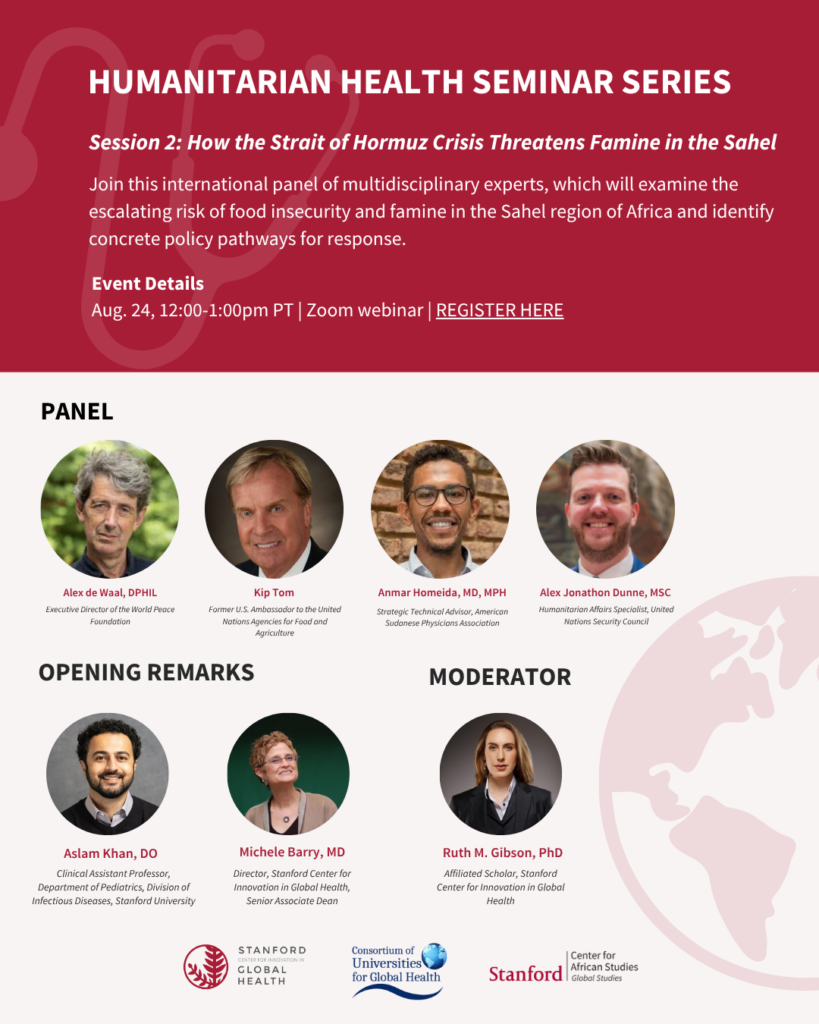
Panel Description
This panel examines a rapidly intensifying polycrisis in the Sahel. The region faces an elevated risk of widespread famine due to the interaction between: fertilizer shortages driven by disruptions to the Strait of Hormuz, ongoing conflict and political instability, and climate variability. The effective closure and sustained disruption of the Strait of Hormuz in 2026 have severely constrained global fertilizer trade. Resulting price spikes and supply shortfalls have impacted African agriculture, particularly in the Sahel, where the timing of the shock coincided with the critical planting window. These external shocks compound longstanding and intensifying local drivers: protracted conflict and displacement, successive political crises, climate extremes (including emerging El Niño risks), and constrained humanitarian access and funding. More than 40–50 million people in the Sahel and West Africa are already experiencing acute food insecurity. The combination of higher input costs, disrupted markets, restricted movement, and degraded livelihoods creates multiplicative rather than additive risks—precisely the conditions under which famine becomes possible.
The session will highlight downstream threats to agricultural productivity, child and maternal nutrition, disease susceptibility, and the resilience of already strained health systems. The forward-looking discussion will focus on policy and diplomatic interventions, famine early-warning and anticipatory action, and coordinated international efforts needed to avert famine and strengthen food systems in the Sahel.
Check back soon for speaker names and details.